Table of Contents
French Onion Soup – Classic Bistro-Style with Slow Caramelized Onions
I still remember the first time I had a truly perfect French Onion Soup. It was during my culinary training in Paris, in a tiny bistro tucked away on the Left Bank. The waiter brought over this little ceramic crock, bubbling with molten Gruyère cheese that stretched for miles as I lifted my spoon. Underneath that glorious golden crust was a deeply savory broth, sweet and complex from onions that had been coaxed into submission over hours. It was one of those food moments that rewires your brain. I knew then that I had to master this soup, and I’ve spent the past twenty years perfecting my version. This French Onion Soup recipe is the result — a classic bistro-style bowl that balances rich caramelized onions with a high-quality beef broth, a splash of wine, and that iconic bubbly Gruyère topping.
The magic of this soup lies entirely in the onions. As they cook low and slow, their natural sugars break down and deepen into something almost buttery and jammy. The aroma that fills your kitchen is pure comfort — sweet, earthy, and slightly savory. Each spoonful is a contrast of textures: the silky, soft onions in a rich broth, the crusty baguette that soaks up all that goodness, and the stretchy, nutty cheese on top that adds the perfect finish. It’s the kind of soup that feels like a hug in a bowl, especially on a cold New York evening when the wind is whipping outside my apartment windows.
What sets my version apart is the technique I learned in Paris for achieving truly deep caramelization without burning. I use a combination of yellow and sweet Vidalia onions for a balance of sharpness and sweetness, and I deglaze the pot with dry white wine throughout the cooking process to lift those flavorful brown bits off the bottom. A splash of Worcestershire sauce and a mix of beef and chicken broth add layers of umami that make this soup unforgettable. My 💡 Pierre’s Pro Tip: patience is non-negotiable — rushing the onions will leave you with a pale, bland soup. But with a little time and love, you’ll be rewarded with the best French Onion Soup you’ve ever had.
Why This French Onion Soup Recipe Is the Best
The Flavor Secret: The heart of this soup is a two-hour caramelization process that transforms ordinary onions into a deeply sweet, savory base. I start by melting butter until it foams — a trick I picked up in Paris that removes excess water, allowing the butter to coat the onions more evenly and preventing them from sticking. I deglaze with a dry white wine like Chardonnay or Pinot Grigio, which adds acidity to balance the sweetness. A blend of high-quality beef broth and chicken broth, plus a touch of Worcestershire sauce, creates a broth that’s rich and complex without being too heavy. It’s a soup that tastes like it simmered all day, but with the right technique, it’s achievable in just over two hours.
Perfected Texture: The onions should be silky and almost melting, not stringy or crunchy. That’s why I slice them into ¼-inch slices — no thinner — so they hold their structure as they cook down. The optional flour addition helps thicken the soup just slightly, giving it a velvety body that clings to the baguette. And the baguette itself is toasted to a golden crisp before being topped with cheese and broiled until bubbly. That final step ensures every bite has that perfect contrast between crunchy, chewy, and gooey.
Foolproof & Fast: While the caramelization takes time, the active work is minimal. This is a mostly hands-off recipe where you just stir every 10–15 minutes. The instructions are broken down into simple steps, and I’ve added pro tips throughout to help you avoid common pitfalls like burning the onions or ending up with a watery broth. Even if you’re a beginner, this recipe is designed to guide you to success. The key is trusting the process — the onions will do the work, and you’ll be rewarded with a soup that rivals any Parisian bistro.
French Onion Soup Ingredients
Whenever I make this soup, I think of my mother’s kitchen in Morocco, where she would caramelize onions for hours to make her tagines. But now in New York, I source my ingredients from the Union Square Greenmarket and my local Italian deli. The high-quality beef broth is non-negotiable — I always opt for a low-sodium brand so I can control the salt. Here’s everything you’ll need to make this classic French Onion Soup.
Ingredients List
- 4 large yellow onions (about 2 lbs) – see notes for pound conversion
- 2 large sweet onions (Vidalia) (about 1 lb)
- 6 Tablespoons butter
- 2 sprigs fresh thyme
- 2 Bay leaves
- ¾ cup dry white wine (Chardonnay or Pinot Grigio)
- 3 tablespoons flour (optional) – for thickening
- 4 cups beef broth (high quality is key)
- 1 beef bouillon cube (or 1 tsp Better Than Bouillon)
- 1.5 cups chicken broth
- 1 teaspoon Worcestershire sauce
- Salt and pepper to taste
- 1 baguette
- 3 Tablespoons olive oil (optional) – for brushing baguette
- 6 slices Gruyere cheese
Ingredient Spotlight
Onions: The star of the show. Yellow onions provide a robust, sharp flavor that mellows beautifully, while sweet Vidalias add natural sugar for deeper caramelization. I recommend organic onions for the best taste. For a substitute, use all yellow onions and add a pinch of sugar to boost caramelization.
Gruyere Cheese: This Swiss cheese is essential for that rich, nutty, and slightly sweet flavor that melts into a perfect golden crust. If you can’t find Gruyère, use Swiss or Emmental cheese. Provolone also works in a pinch, though the flavor will be milder.
Dry White Wine: A Chardonnay or Pinot Grigio adds acidity and depth. Avoid sweet wines like Riesling. If you don’t drink alcohol, use an equal amount of additional beef broth plus 1 tablespoon of apple cider vinegar for a similar effect.
High-Quality Beef Broth: This is the backbone of the soup. I prefer a low-sodium organic beef broth from the refrigerated section. Better Than Bouillon is a great shelf-stable option. Avoid cheap, watery broths — they’ll make the soup taste flat.
| Original Ingredient | Best Substitution | Flavor / Texture Impact |
|---|---|---|
| Gruyère cheese | Swiss cheese or Emmental | Slightly milder, still melts well. Good for a budget-friendly option. |
| Dry white wine | Extra beef broth + 1 tbsp apple cider vinegar | Adds acidity without alcohol. Flavor is slightly sharper but still works. |
| Vidalia onions | Use all yellow onions + 1 tsp sugar | Adds sweetness through sugar. Caramelization may be slightly less complex. |
| Baguette | Sourdough bread or ciabatta | Chewier texture. Toast well and still holds up in the broth. |
How to Make French Onion Soup — Step-by-Step
Making French Onion Soup is a labor of love, but it’s incredibly rewarding. Follow these steps carefully, and you’ll have a bowl that tastes like it came from a Parisian bistro. The key is to go slow and trust the process.
Step 1: Slice the Onions
Slice the onions into ¼-inch slices — no thinner. They’ll reduce in size quite a bit, and you don’t want them to be too stringy. Using a mandoline slicer makes this much easier and ensures even slices. I like to wear a pair of kitchen goggles to avoid tears — a little trick from my Moroccan grandmother!
💡 Pierre’s Pro Tip: If you’re using a mandoline, guard your fingers carefully. The last thing you want is a cut before you even start cooking. Take your time.
Step 2: Melt the Butter
Melt the butter in a large soup pot or dutch oven over medium-low heat. Wait until it begins to foam — this allows water to evaporate out, leaving the butter more clarified and smooth. This is a technique I learned in Paris: foaming the butter ensures it won’t burn as the onions caramelize.
⚠️ Common Mistake to Avoid: Don’t use high heat. Butter will burn quickly, and that will ruin the soup with a bitter taste. Keep it low and slow.
Step 3: Add Onions and Start Caramelizing
Add the onions and use tongs to toss and coat them in the butter. Leave them uncovered as they cook. The onions will caramelize slowly, up to 2 hours or longer. Stir them every 10–15 minutes. As the onions caramelize, they may leave some brown residue at the bottom of the pot. Add a splash of wine and use a silicone spatula to “clean” the bottom of the pot. Repeat as needed throughout the cooking process.
💡 Pierre’s Pro Tip: The brown residue (called “fond”) is pure flavor. Deglazing it with wine lifts that flavor back into the onions. This is the secret to a deeply savory soup.
Step 4: Add Flour and Remaining Wine
When the onions are nearly done — a rich brown and sweet — sprinkle flour over them and cook for 2 minutes. This helps thicken the soup slightly. Add any remaining wine and increase the heat to medium-high. Toss the onions more frequently. They are done when they are richly brown and sweet, almost like a jam.
⚠️ Common Mistake to Avoid: If you skip the flour, your soup will be thinner. It’s optional, but I recommend it for a more luxurious texture. Just make sure you cook it for 2 minutes to remove the raw flour taste.
Step 5: Add Broths and Simmer
Add the beef broth, beef bouillon, chicken broth, Worcestershire sauce, bay leaves and thyme. Simmer over medium heat for 45 minutes with the lid cracked. This allows the flavors to meld and the broth to deepen. Stir occasionally and taste as you go.
💡 Pierre’s Pro Tip: Don’t skip the cracked lid. It allows steam to escape, concentrating the flavors. If you seal it tightly, the soup will be watery and diluted.
Step 6: Preheat Oven and Prep Baguette
While the soup simmers, preheat the oven to 350°F. Slice the baguette into ½-inch thick slices. Brush the tops with olive oil and bake for about 5 minutes, until lightly golden. This toasting step is crucial — it prevents the bread from turning into a mushy mess in the soup.
⚠️ Common Mistake to Avoid: Don’t skip the toasting. Untoasted bread will dissolve into the soup, leaving you with a starchy, soggy mess. A proper toast gives structure.
Step 7: Add Cheese and Broil
Increase the oven temperature to 450°F. Top each baguette slice with cheese and bake in the oven until the cheese melts and begins to bubble and brown. This usually takes about 5-7 minutes. Keep an eye on it — you want it golden and bubbly, not burnt.
💡 Pierre’s Pro Tip: For an extra bubbly crust, place the cheese-topped baguettes on a baking sheet and place them directly under the broiler for the last minute. But watch closely — broilers are powerful!
Step 8: Season and Serve
Remove the bay leaves and thyme stems from the soup. Season to taste with salt and pepper. Ladle the warm soup into each bowl and top each of them with the warm baguettes. Serve immediately while the cheese is still hot and stretchy.
💡 Pierre’s Pro Tip: Always taste the broth before adding salt. The cheese and broth can be salty on their own. Start with a light hand and adjust at the table.
| Step | Action | Duration | Key Visual Cue |
|---|---|---|---|
| 1 | Slice onions | 15 mins | Even ¼-inch rings |
| 2 | Melt butter | 5 mins | Foaming, not browning |
| 3 | Caramelize onions | Up to 2 hours | Rich brown, sweet |
| 4 | Add flour & wine | 2 mins | Flour is cooked, onions coated |
| 5 | Simmer soup | 45 mins | Broth deepens in color |
| 6 | Toast baguette | 5 mins at 350°F | Light golden brown |
| 7 | Broil cheese | 5–7 mins at 450°F | Bubbly and golden |
| 8 | Season & serve | 5 mins | Hot broth, top with baguettes |
Serving & Presentation
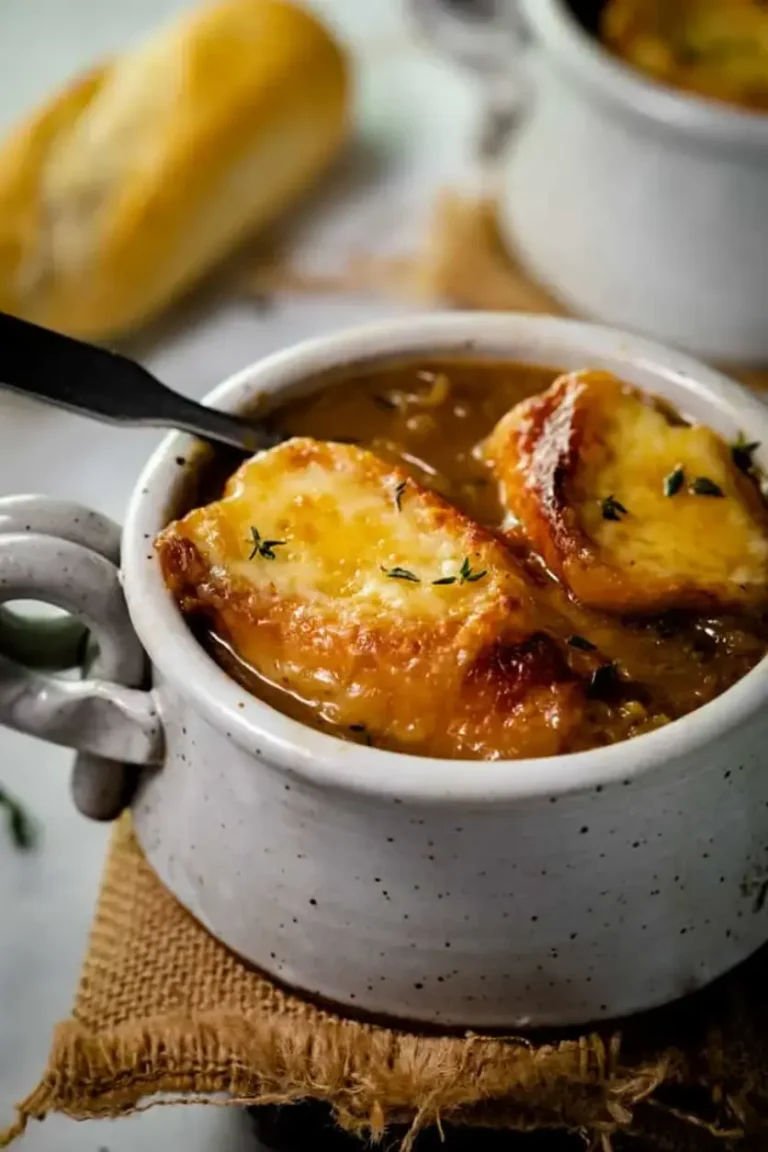
I love serving this French Onion Soup in classic ceramic crocks — they keep the soup hot and the cheese bubbly. Place each crock on a small plate or napkin to catch any drips. For a rustic touch, I sometimes add a few fresh thyme leaves on top of the cheese before broiling. The contrast between the green herb and the golden cheese is stunning.
In my New York City kitchen, I like to pair this soup with a simple green salad dressed with a bright vinaigrette — the acidity cuts through the richness of the soup. A glass of dry white wine, like a Chardonnay, is a natural match. Sometimes I’ll add a small side of crusty bread for extra dipping, but honestly, the baguette in the soup is usually enough. My mother would have served this with a sprinkle of fresh parsley and a warm smile, and I do the same.